Egypt · One object
The Stele of Revealing
A painted wooden funerary stele, about fifty centimetres high, made for the Theban priest of Montu Ankh-ef-en-Khonsu around 680–670 BCE. It joins image, offering and funerary text to sustain his passage into the next world. In 1904 the same object became the Stele of Revealing and a foundational sacred object of Thelema. Its Egyptian purpose and its Thelemic religious life are both central to its history.

What it is
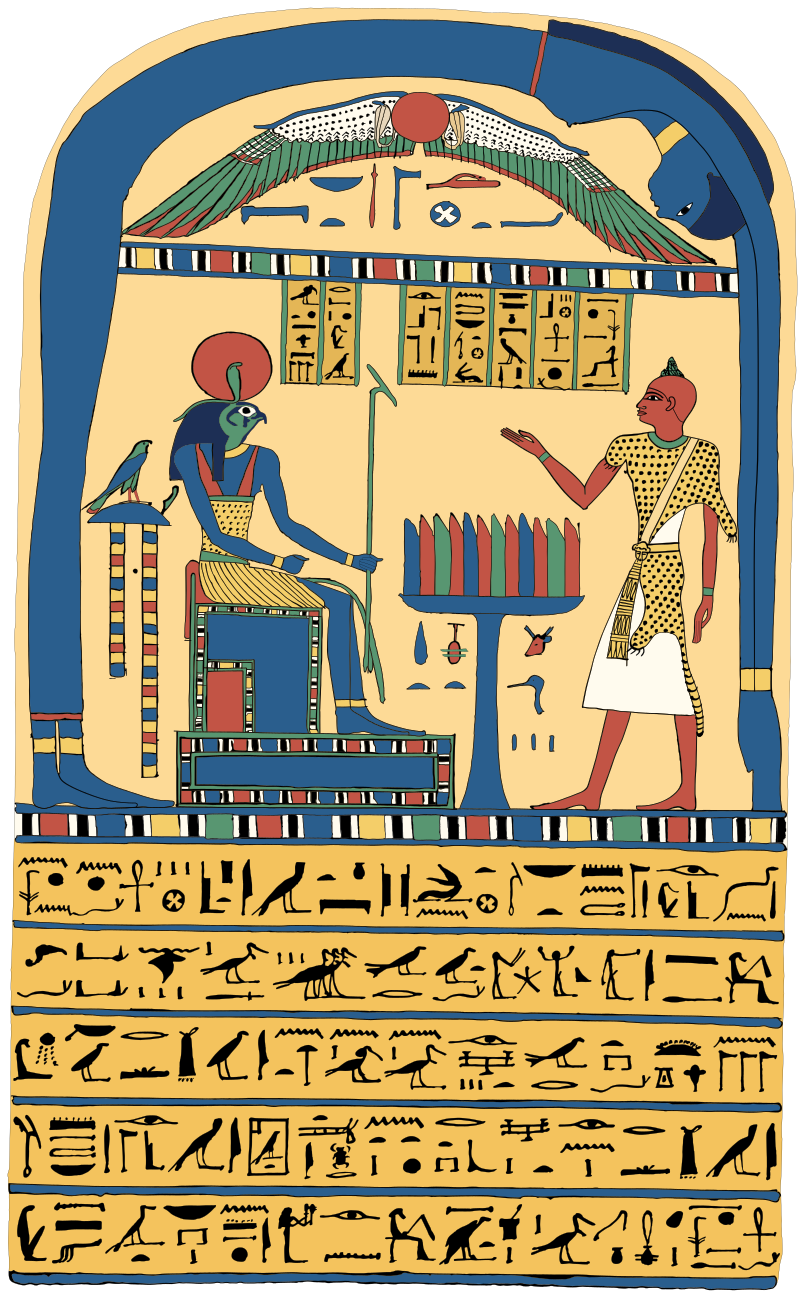
Ankh-ef-en-Khonsu stands at the right presenting offerings to Ra-Horakhty, the enthroned Re-Horus-of-the-Two-Horizons. Above them Behdety's winged solar disk extends across the scene, and the sky goddess Nut arches protectively over the whole composition. The text names and equips Ankh-ef-en-Khonsu for his continuing life among the gods. Image, speech and offering work together here as an act of Egyptian funerary religion.
Attested in Egyptian sources Cairo A 9422, c. 680–670 BCE, 51.5 × 31 cm.
How it came to be numbered 666
The stele was excavated at Deir el-Bahari in the 1850s and entered the Boulaq Museum, where it carried the inventory number 666. Around 1902 the collection moved to the new Egyptian Museum in Cairo and the stele became A 9422; it has since moved again, to the Grand Egyptian Museum at Giza. The number 666 was a cataloguer's running number and had no Egyptian significance. It mattered greatly to Crowley, who already identified himself with that number, and the coincidence helped make the stele revelatory for him. That meaning belongs to its reception in 1904, not to its seventh-century BCE context.
March 1904
Aleister Crowley and his wife Rose Kelly were in Cairo. On 21 March 1904 she took him to the museum and identified the figure on this stele as the god who had been pressing on her. Crowley had a translation made for him by the German Egyptologist Émile Brugsch, named the object the Stele of Revealing in April, took Ankh-ef-en-Khonsu as his own magical name, and in the same month wrote Liber AL vel Legis, which opens with the sky goddess of this stele and is the foundation of Thelema.
Thelema reads the stele's three divine figures as the three deities of its new aeon: Nut as Nuit, infinite space and the stars; Behdety's winged solar disk as Hadit, the infinitely contracted point; and Ra-Horakhty as Ra-Hoor-Khuit, the crowned and conquering child. In the Egyptian funerary scene, Nut encloses the cosmos, Behdety extends solar protection and Ra-Horakhty receives Ankh-ef-en-Khonsu's offering. The Thelemic identification was not offered as a philological reading of the original scene. It dates from 1904 and belongs to the object's later occult reception, where it remains religiously significant.
| On the stele | What it is in Egyptian terms | In Thelemic reception |
|---|---|---|
| Nut | Nut, arched over the scene | Nuit, infinite space and the stars |
| Horus | Behdety, the winged solar disk | Hadit, the infinitely contracted point |
| Ra | Ra-Horakhty, enthroned as the priest presents offerings | Ra-Hoor-Khuit, the crowned and conquering child |
Modern occult and initiatory traditions The right-hand column records the religious reading Thelema developed from this object in 1904.
Why the stele matters in both contexts
The stele belongs to two distinct histories. It is a genuine seventh-century BCE Egyptian funerary object, properly dated and catalogued, whose figures and original purpose can be studied in their Egyptian setting. In 1904 it also became a foundational sacred object of Thelema, giving those figures a new religious life that remains consequential and practised today. Neither history displaces the other. Keeping them distinct makes it possible to understand both what the object was made to do and what it later came to mean.
Sources
- the object Stele of Ankh-ef-en-Khonsu Its dimensions, its date, its museum numbers at Boulaq and Cairo, the figures it carries, and the account of March 1904.
- primary text Liber AL vel Legis (1904), cited by chapter and verse and not quoted. The Ordo Templi Orientis asserts copyright in Crowley's work whatever the jurisdiction, which is the answer The Book of Thoth already gets on this site: a locator costs nothing and a quotation is not worth the argument.